Rising Moon
Unraveling the Book of Ruth
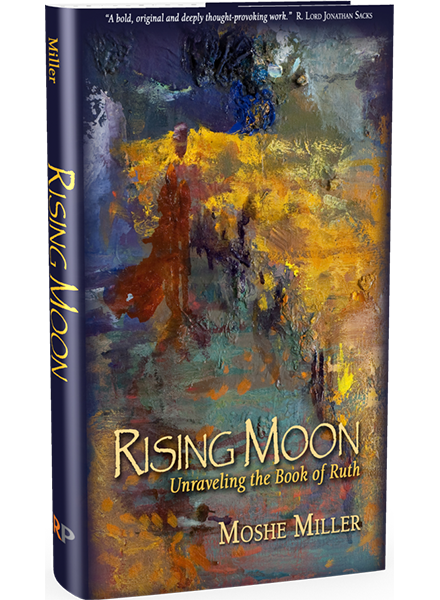
"The birth of the king is also the birth of the ultimate lover and beloved."
Rising Moon is a masterful commentary on the Book of Ruth, exploring the profound themes of Malkhut (Kingship), hesed (loving-kindness), conversion, and Jewish destiny. Through careful analysis of the biblical text and rabbinic literature, Rabbi Miller illuminates how Ruth's story contains the seeds of redemption itself—from the House of David to the Messianic era.
Praise for Rising Moon
"In Rising Moon, Moshe Miller has written a profound meditation on the Book of Ruth, shot through with fresh insights and arresting interpretations. A bold, original and deeply thought-provoking work."
"[This book] will surely blow you over. This is definitely, positively, unalterably good stuff!"
"Rabbi Moshe Miller's commentary on Ruth is creative and absorbing at virtually every turn. It combines many virtues: intellectual power, erudition, psychological and philosophical insight, and sensitivity to nuances of language and character. The author presents subtle, imaginative connections between the Megillah and a wide array of biblical and midrashic texts and themes. The result is a complex yet moving account of Ruth and of how Hazal understood this beautiful narrative and its place in the life of our people."
"Inspired by rich and variegated strands of wisdom in Hazal, Rabbi Miller … threads new connections between words and ideas in the pesukim; he uses these to weave a spellbinding interpretive tapestry … By the time we go through Ruth with Rabbi Miller as a guide, we view Jewish history and destiny from a new perspective … I learned something new on almost every page. It is a great book [and] it belongs on the bookshelf of every Jewish home."
"Rabbi Moshe Miller has a mastery of the sources and a unique and uncanny ability to weave together seemingly disparate clues, allusions and facts in a way that produces a seamless tapestry of a story that is the foundation of the royal house of Israel."
"This book is powerful stuff… R. Miller combines literary and psychological sensitivity with a midrashic outlook, somewhat along the lines of Aviva Zornberg. Additionally, I find the commentary very in tune with current trends in our community. R. Miller is very sensitive to issues of power and autonomy, without being radical and anti-authoritarian. He does all this while heeding to a careful reading of the text. This book is nothing short of a masterpiece."
Rabbi Berel Wein, Z"TL
Rabbi of Beit Knesset Hanasi, Jerusalem
Founder and Director of the Destiny Foundation
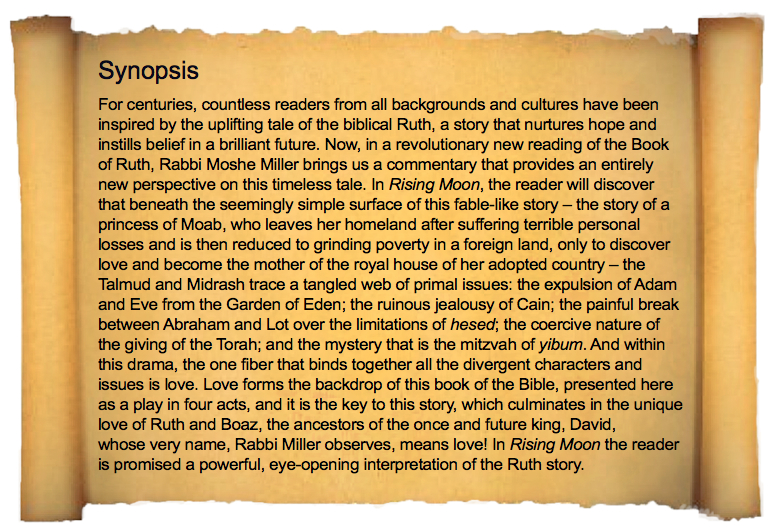
Synopsis
Book Excerpt
The roots of Megillat Ruth go deep. Forming the backdrop is the saga of Abraham, Lot, and Sodom. Yet, as we have intimated, there are threads that reach back even farther, back to the dawn of history itself, to the very act of Creation. We are told that "olam hesed yibaneh" – "the world is built of hesed" (Psalms 89:3) – and with that formation of hesed comes the existential paradox we have been discussing: with each giving of hesed there is also a taking – with every act of hesed, independence is taken away. Hesed means not only kindness, but shame. The recipient becomes a dependent and views himself as inferior for having received. This paradox is what drove Lot away from Abraham. But it is not only Abraham who is compromised by the internal contradictions of "hesed-kindness-shame."
Read MoreFood for Thought
Questions that guide the exploration of Ruth's timeless narrative.
Why is food – namely, bread and famine – such an important motif in the story?
Why must King David and, ultimately, the Messiah, emerge from such an unusual gene pool – the union of Boaz, the leader of his generation and head of Sanhedrin and Ruth, a destitute, Moabite convert who traces her lineage to Lot and Sodom?
Why does hesed (kindness) lie at the heart of the most important existential paradox of Creation?
Why do Hazal (our Sages) describe kabbalat haTorah (the receiving of the Torah) as coercive? And how does this relate to Megillat Ruth?
Why is questionable and suggestive behavior such an important ingredient in the creation of malkhut Yisrael (the kingdom of Israel) from Ruth and Boaz in the granary to David and Avishag at the coronation of Solomon?
What is the true nature of geirut (conversion)?
Why is yibum (levirate marriage) the core concept of Megillat Ruth?
Rising Moon answers these and many other questions that define the nature of the Jewish soul.
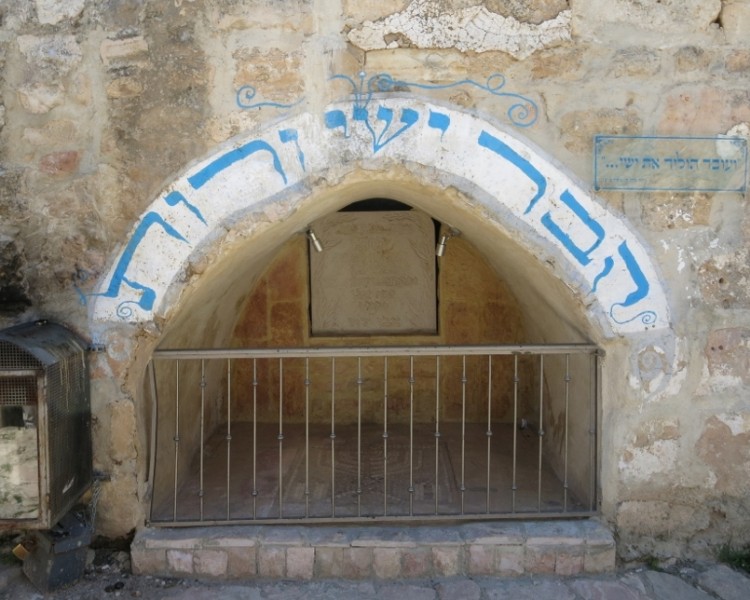
The Burial Plot of Ruth and Yishai – the father of King David. It is located on the top of Mount Hebron.
"So Boaz took Ruth, and she was his wife… And these are the generations of Peretz: Peretz begat Chetzron. And Chetzron begat Ram and Ram begat Aminadav. And Aminadav begat Nachshon, and Nachshon begat Salma. And Salmon begat Boaz and Boaz begat Oved. And Oved begat Yishai and Yishai begat David." — Ruth 4:18-22